Sinatra
How a Sinatra app embeds droplets: a route fetches each fragment with
Net::HTTP and an ERB view prints it into the page.
The pattern in Sinatra
Section titled “The pattern in Sinatra”# shop.rb (trimmed)def shop_fragment(id, params = []) headers = { "accept" => "text/html", "x-droplet-location" => SHOP_ORIGIN, "referer" => SHOP_ORIGIN + shop_raw_target } cookie = shop_cookie_header headers["cookie"] = cookie if cookie target = "/droplets/#{URI.encode_www_form_component(id)}?#{URI.encode_www_form(params)}" result = { html: "", status: 502, location: nil, cookies: [], link: nil } response = shop_request("GET", target, headers) # Net::HTTP to SHOP_INTERNAL_URL code = response.code.to_i result.merge!(status: code, cookies: response.get_fields("set-cookie") || [], link: response["link"]) if (300..399).cover?(code) result[:location] = response["location"] elsif (response.is_a?(Net::HTTPSuccess) || code == 500) && response["content-type"].to_s.start_with?("text/html") result[:html] = response.body.to_s.force_encoding("UTF-8") return result end # … anything else: result[:html] becomes a "droplet is unavailable" note resultend<%# views/shop/layout.erb, in <head>: once per page %><script type="module" src="/index.js"></script><%# views/shop/gallery.erb: the fragment's HTML, as it came %><aside><%= fragments[0] %></aside>shop_fragmentsendsGET /droplets/<id>?<params>toSHOP_INTERNAL_URLwithaccept: text/htmlandx-droplet-locationset toSHOP_ORIGIN, the origin ofSHOP_PUBLIC_URL. It passes on the browser’sCookiecut down to the shop’s owncart_idandshop_admin, and the page’s URL asreferer:SHOP_ORIGINplus the path and query as the browser sent them (shop_raw_target).Net::HTTPnever follows a redirect, so a droplet’s 3xx is kept:shop_renderanswers it withhalt, and sends the fragments’Set-Cookiewith the page.- Only a
text/htmlanswer (a 2xx, or a 500 carrying the droplet’s error page) is pasted;<%= %>prints it unescaped. views/shop/layout.erbloads/index.jsonce.SHOP_PROXIED, routed for every verb, passes/index.js,/env.js,/index.css,/droplets/*,/assets/*and/api/*on to the shop.
The shop demo, recorded
Section titled “The shop demo, recorded”The shop demo on Sinatra 4, recorded by the end-to-end test. How the pieces fit has the diagram.
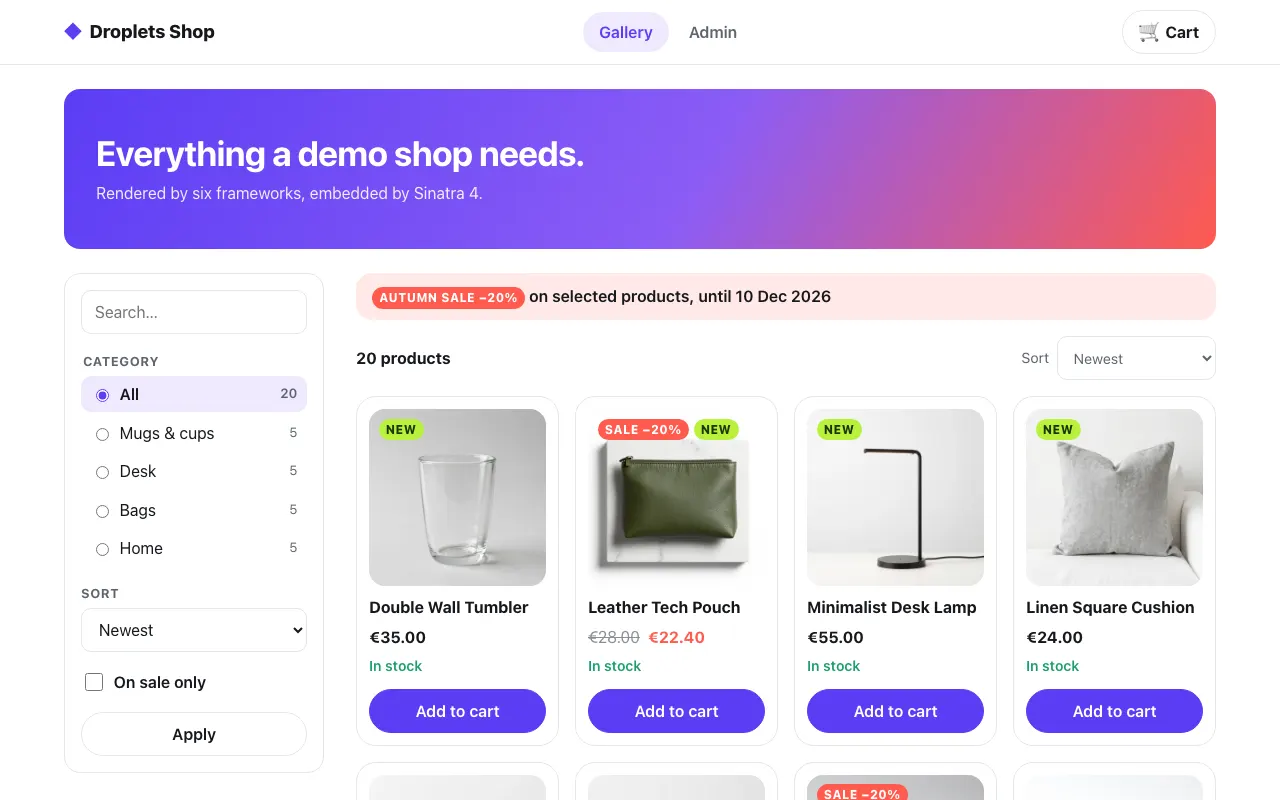 The gallery
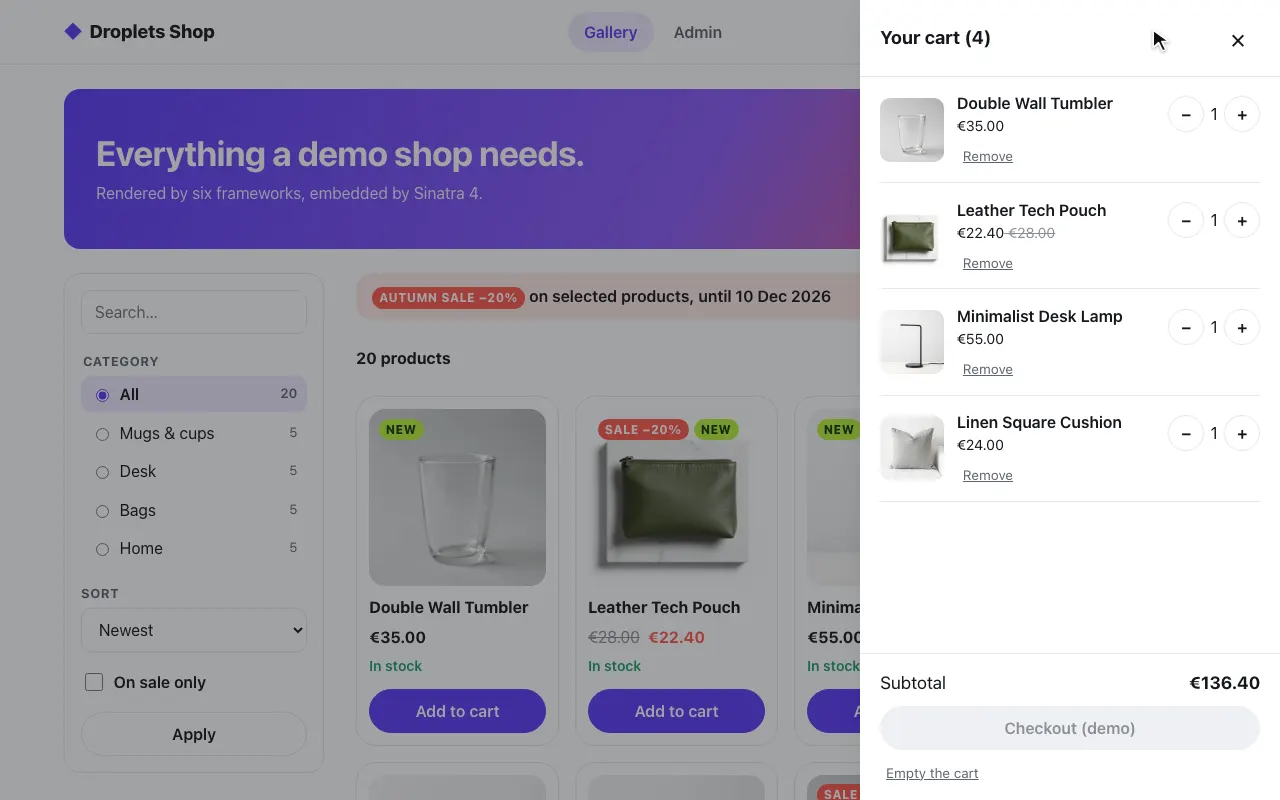 A product in the cart
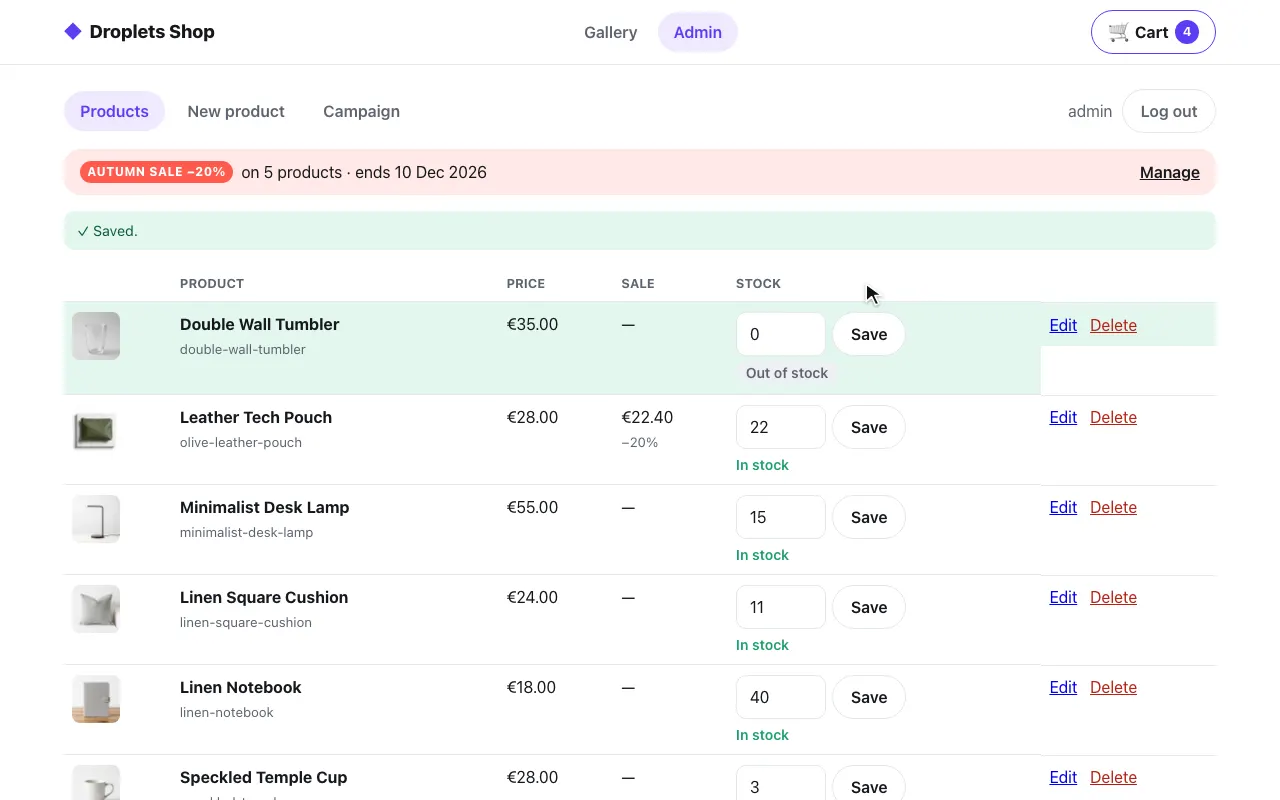 The admin: stock set to 0
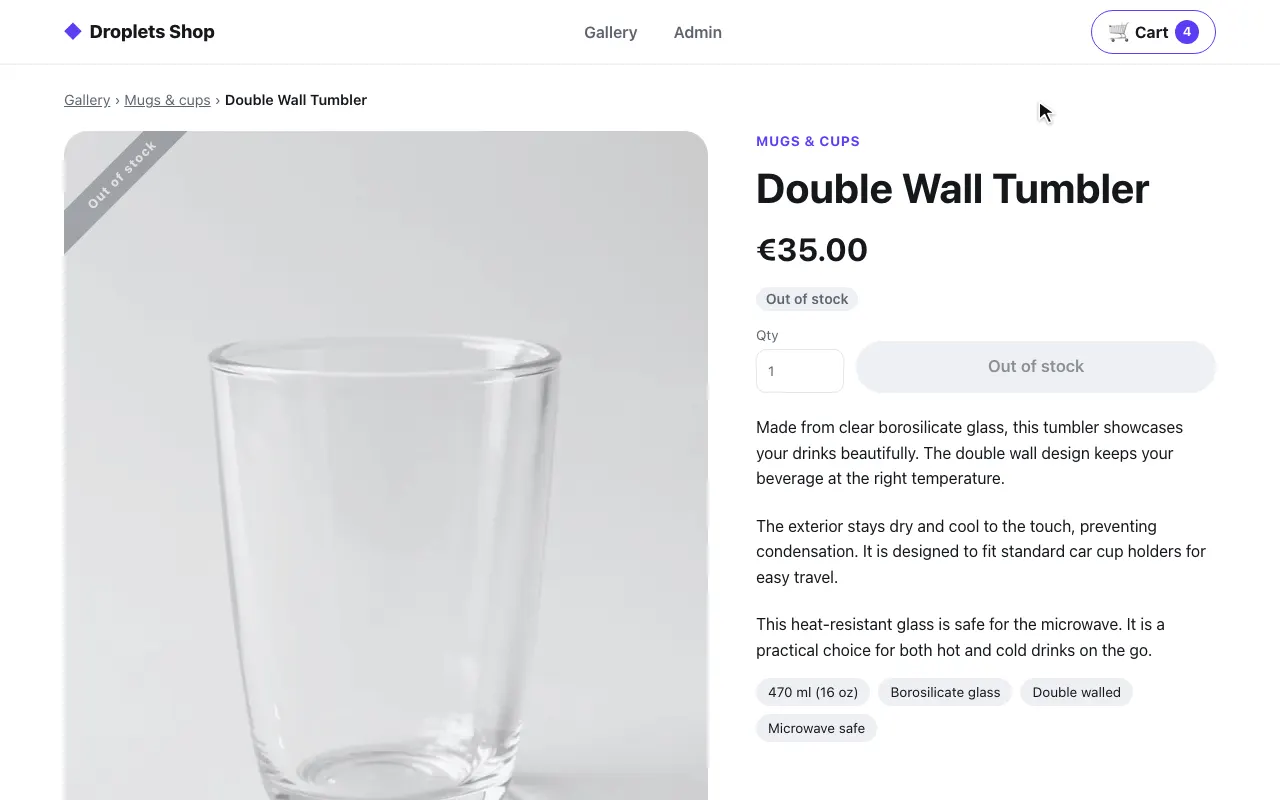 The product page: out of stock
The code is examples/hosts/sinatra/shop.rb (required by app.rb) and the
ERB views in views/shop/.
Pieces and ports
Section titled “Pieces and ports”docker-compose.yml starts three services:
| Service | Port | What it is |
|---|---|---|
web |
8002, public | Sinatra: the shop’s pages, the proxy, and the basic page at / |
shop |
8300, internal only | the shop’s droplets server (examples/shop) |
droplets |
8000, public | the Svelte example’s droplets server, for / only |
On web |
Value | Used for |
|---|---|---|
SHOP_INTERNAL_URL |
http://shop:8300 |
internal: fragment fetches and the proxy |
SHOP_PUBLIC_URL |
http://localhost:8002 |
public: this host’s own origin, sent as x-droplet-location |
DROPLETS_INTERNAL_URL, DROPLETS_PUBLIC_URL |
http://droplets:8000, http://localhost:8000 |
the same pair, for the basic page |
How a page gets a droplet
Section titled “How a page gets a droplet”A server fetch with Net::HTTP, one thread per fragment, rendered into ERB.
The fetch is shop_fragment and the view is views/shop/gallery.erb, both
shown in the pattern above; the fragments’ Link preloads go into <head>.
shop_render runs the fetches:
results = requests.map { |id, params| Thread.new { shop_fragment(id, params) } }.map(&:value)referer is the page’s URL, query included. The shop’s handle reads it
with hostFrom, so it is the droplet’s
host, and after
a form posted without JavaScript its query carries the form’s result.
views/shop/layout.erb loads <script type="module" src="/index.js"> once,
through the proxy, and each droplet hydrates itself. shop_render fetches
the toasts and the header’s cart badge with every page’s fragments; the
toast-center fragment comes first in the body, and /index.js installs
window.shopMessageQueue before any droplet starts (the shop’s
src/hooks.client.ts):
<%# views/shop/layout.erb %><body class="shop"><%= @shop[:toasts] %><header class="shop-header">…<div class="shop-cart"><%= @shop[:cart] %></div>…</header>The product page first reads the product from the shop’s public
GET /droplets/product-page/_data?slug=<slug>; an unknown slug renders the
not_found view with 404. The pages pass on only the query keys each
droplet takes: the whole query to product-filter and product-library,
order, page and showing (plus productId) to product-comments,
slug and v to product-page, next to login, view and id to
product-admin.
What it proxies
Section titled “What it proxies”SHOP_PROXIED = %r{/(?:index\.js|env\.js|index\.css|(?:droplets|assets|api)/.*)}%i[get post put patch delete options].each do |verb| send(verb, SHOP_PROXIED) { shop_proxy }end/index.js, /env.js, /index.css, /droplets/* (fragments, _data, form actions), /assets/*
and /api/* go to shop_proxy, for those verbs and HEAD, which Sinatra
routes with every get. It sends the shop x-droplet-location written
out. Of the browser’s headers it sends only accept, accept-language,
content-type, if-none-match, origin, referer, user-agent,
x-droplet-props and x-droplets-build, plus cookie cut down to the
shop’s own cart_id and shop_admin (another app’s cookie on this origin
stays here), with accept-encoding: identity so the body comes back as it
is. The target is the raw path and query
concatenated onto the shop’s base, never resolved, so //elsewhere stays a
path on the shop. The answer comes back with its status, every Set-Cookie
and any redirect, without connection, keep-alive, transfer-encoding,
content-encoding and content-length. Net::HTTP waits 5 seconds to
connect and 10 to read; a shop that cannot be reached answers 502
The shop is unreachable.
The shop’s cookies are first-party, and nothing is cross-origin; the shop
sets them only from form actions and /api, which come through here.
Gotchas
Section titled “Gotchas”- Sinatra reads a form body before the route runs, and the server’s input
cannot be rewound. A small middleware (
ShopBufferedInput) buffers it so the proxy can pass the same body on, up to 4 MB (the admin’s image uploads; a bigger body is a413), andmethod_overrideis off, sinceRack::MethodOverridewould read it even earlier. - Sinatra’s ERB does not escape
<%= %>by default, which is how the fragments are pasted; the views escape everything else withh(). See For hosts. - The page is
private, no-store.shop_rendersets it before it answers the page or a fragment’s redirect: the fragments were rendered with the visitor’s cookies.
Run it
Section titled “Run it”cd examples/hosts/sinatradocker compose up --buildopen http://localhost:8002/gallery # log in as admin / dropletsSet SHOP_SECRET and DROPLETS_SECRET first; compose refuses to start
without them. The shop trusts one origin besides its own,
DROPLETS_TRUSTED_ORIGINS: http://localhost:8002, this host’s; the rest of
its environment is the same on every host: see
Running a host.
The Svelte example
Section titled “The Svelte example”The same app serves the Svelte example at /: its three droplets, one per
mode, from examples/frameworks/svelte (the droplets service), fetched one
after the other.
# app.rb (trimmed)DROPLETS_INTERNAL_URL = ENV.fetch("DROPLETS_INTERNAL_URL", "http://localhost:8000")DROPLETS_PUBLIC_URL = ENV.fetch("DROPLETS_PUBLIC_URL", "http://localhost:8000")
IDS = %w[client ssr-hydrate ssr-nohydrate].freeze
def fetch_droplet(droplet, props = {})  uri = URI("#{DROPLETS_INTERNAL_URL}/droplets/#{droplet}")  uri.query = URI.encode_www_form(props) unless props.empty?
  # Net::HTTP never follows a redirect.  response = Net::HTTP.start(uri.host, uri.port, open_timeout: 5, read_timeout: 5) do |http|    http.get(uri.request_uri, { "accept" => "text/html", "x-droplet-location" => DROPLETS_PUBLIC_URL })  end  # Only an HTML answer is a fragment (a 500 carries the droplet's error  # page); anything else may echo the props, so it is never pasted.  is_html = response["content-type"].to_s.start_with?("text/html")  return response.body if (response.is_a?(Net::HTTPSuccess) || response.code == "500") && is_html
  %(<p class="error">droplet "#{Rack::Utils.escape_html(droplet)}" unavailable: HTTP #{response.code}</p>)rescue StandardError => e  %(<p class="error">droplet "#{Rack::Utils.escape_html(droplet)}" unavailable: #{Rack::Utils.escape_html(e.message)}</p>)end
get "/" do  @droplets_public_url = DROPLETS_PUBLIC_URL  who = params.fetch("who", "Sinatra")  @fragments = IDS.map { |id| fetch_droplet(id, who: who) }  erb :indexend
<%# views/index.erb %><script type="module" src="<%= @droplets_public_url %>/index.js"></script>…<% @fragments.each do |fragment| %> <%= fragment %><% end %>Here the page loads /index.js from the droplets server’s public URL,
another origin than the page, so the Svelte example runs with cors: true
and DROPLETS_TRUSTED_ORIGINS lists both DROPLETS_URL and this host’s
WEB_URL. Rails works the same way: fetch in the controller, raw or
html_safe in the view.